The first rush around artificial intelligence has settled. Organisations can now look more clearly at what it actually does in recruitment. Vendors have raced to embed third-party models in their platforms. InterManagement has explored the same path, including OpenAI capabilities at points in the candidate journey.
Those integrations have improved candidate engagement. They have also exposed limits that product marketing tends to bury. The first distinction hiring leaders need is between machine learning and basic automation. Many tools sold as “AI” are rule-based chatbots: pre-programmed steps with no natural language understanding and no adaptive learning. Building real AI infrastructure from scratch takes technical resources most enterprises do not have, and do not need to own.
Key vulnerabilities of AI in hiring
1. The data dilemma and bias
AI systems depend on data. In talent acquisition they need large pools covering hiring history, skill shifts, and job-seeker demographics.
- Many small and mid-market organisations do not have that volume, so predictive accuracy falls away.
- Where the data exists, historical gaps and inconsistency can make the system repeat and amplify hiring bias, with compliance and ethical consequences.
- Recruitment data is usually fragmented across the funnel. End-to-end control is rare. AI is more realistic in isolated stages — screening or scheduling — than as the governor of the whole process.
2. Keyword rigidity and overlooked talent
Many résumé parsers lean on exact keyword matches.
- Candidates with unconventional careers, or who describe achievements in different words, are filtered out.
- A person can have the skill and still miss the vocabulary the algorithm was told to prefer. High-potential talent leaves the pipeline before a person has seen them.
3. Latency and the candidate experience
Speed is still a bottleneck. Using a backend model to draft job descriptions from thousands of requisitions can take up to thirty seconds.
- A consumer AI interface can feel faster, but it then draws on generic external data rather than the company’s own job library.
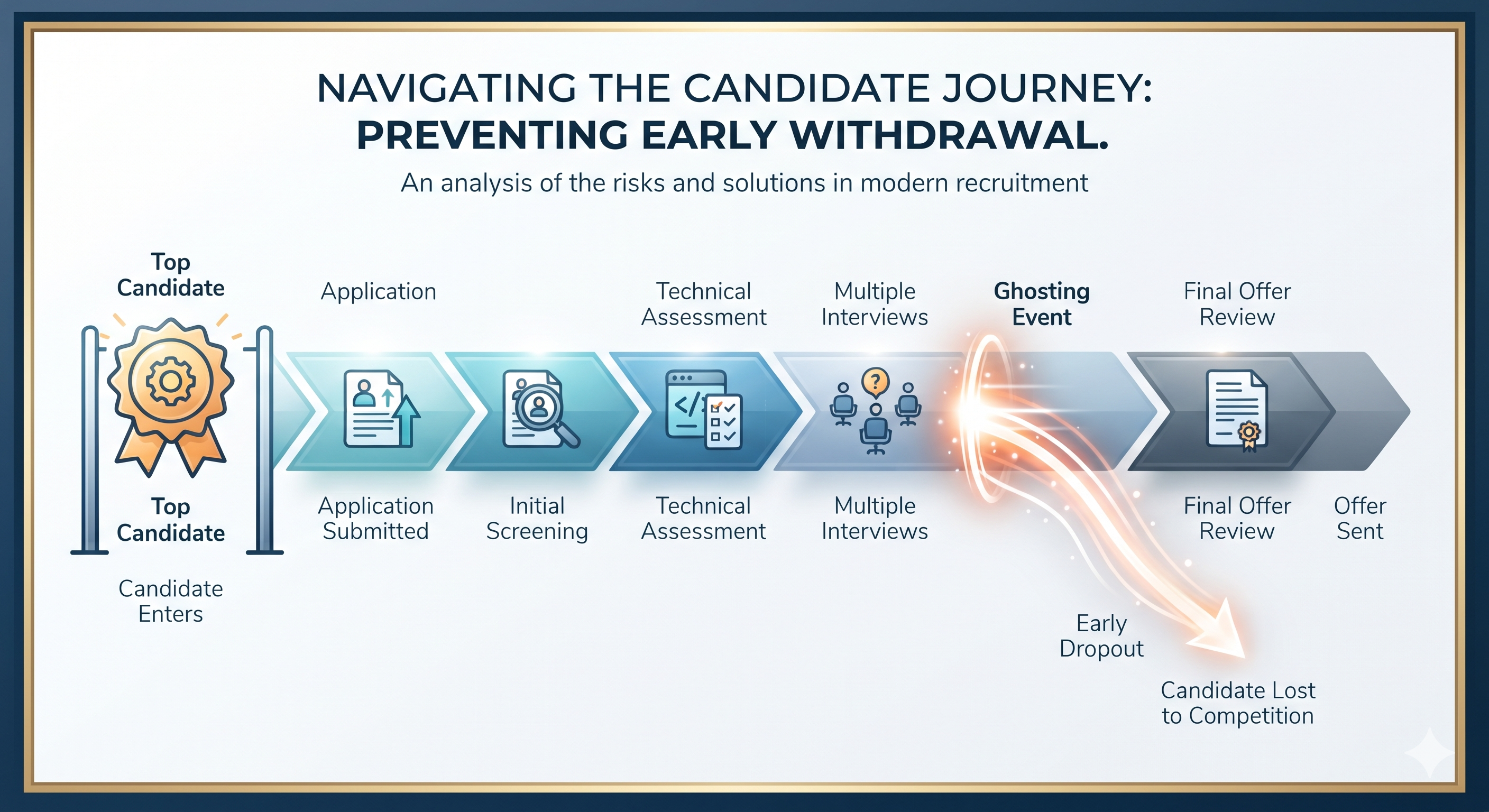
- Thirty seconds may be tolerable for an internal recruiter. For an active job seeker it is friction. In competitive markets, slow responses raise drop-off. Conversational chatbots can also make a simple task — “are there roles in my region?” — take longer than a straightforward search.
4. The limit of human judgement
AI does not think. It calculates probabilities from historical patterns. It is useful for structured administration: parsing data, drafting descriptions. It does not measure emotional intelligence, cultural alignment, adaptability, or how someone will work with other people. Those hiring decisions still need human intuition and executive judgement. Technology is blind there.
A balanced approach
Recruitment technology will keep moving. A clear view of both its power and its boundary is what keeps it useful. AI is a strong tool for administrative work and repetitive tasks. Evaluating soft skills, checking cultural fit, and projecting a career still require people. Talent leaders who hold that line can use the innovation without buying the hype.