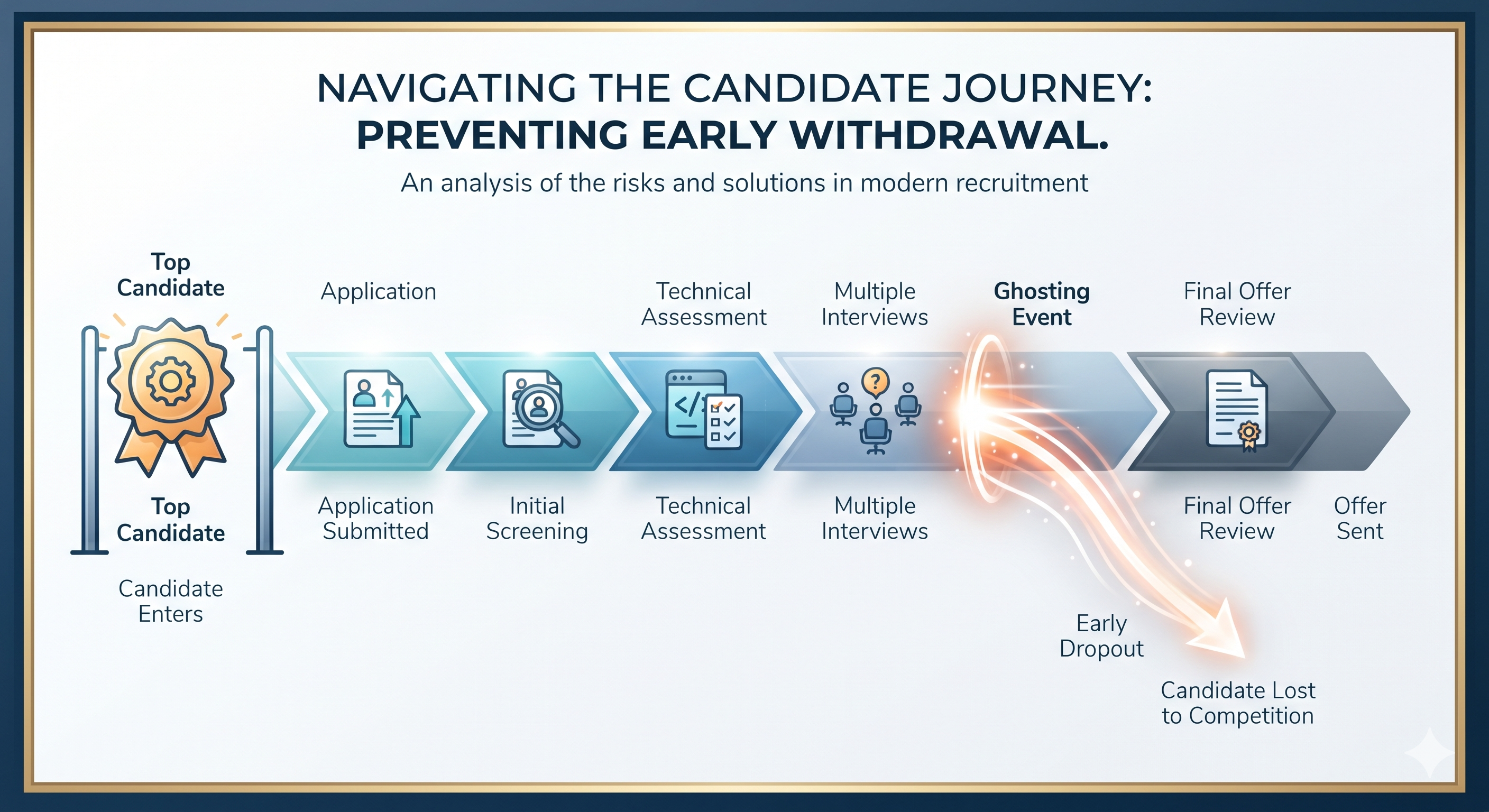
Decoding the final-hour candidate drop after the offer: why it happens, and how international recruiters can keep placements from collapsing at the finish line.
For any international recruitment agency, there are few frustrations quite like reaching the finish line of a rigorous hiring process only to experience a last-minute withdrawal. After weeks of screening, multiple rounds of interviews, salary negotiations, and final agreement on a lucrative compensation package, the overseas employer issues the formal offer letter.
And then, the candidate declines.
The reasons given are often deeply personal and seemingly abrupt: “My current employer countered with a promotion and a retention raise,” “My family is refusing to let me relocate abroad,” or “My mother or father has fallen seriously ill.”
While these explanations sound like sudden developments, in international recruitment they are usually the symptoms of deeper underlying psychological vulnerabilities, family dynamics, and operational bottlenecks that went unaddressed during the hiring pipeline. Understanding why candidates get cold feet at the eleventh hour — and how recruitment teams can insulate their placement processes against these drop-outs — is critical for closing deals successfully.
The anatomy of overseas recruitment: where momentum dies
To understand late-stage withdrawals, we must first look at the unique structural challenges of international hiring workflows. Unlike domestic hiring, securing an overseas position involves a protracted, multi-layered approval chain.
Typically, the overseas employer’s HR department conducts a preliminary screening interview to shortlist candidates. This is followed by a technical or operational evaluation by the hiring department or technical team. Finally, corporate administration or executive management enters the picture to approve budgets before the formal offer letter is issued.
Unfortunately, this complex chain often creates significant friction:
- Protracted time gaps. The long time gap between the initial screening, the second technical interview, and the final administrative sign-off can stretch across several weeks or even months.
- The administrative delay. When weeks pass between the verbal agreement on salary and the actual issuance of the offer letter, momentum completely stalls.
The psychological impact of delays and late-stage withdrawals
When the hiring process drags on and administrative delays occur, it triggers severe psychological shifts in the candidate.
Erosion of enthusiasm and trust
During the initial interview stages, the candidate’s excitement and engagement are at their peak. However, a lengthy gap between interviews or a delayed offer letter signals disorganisation or indifference from the employer. Candidates begin to wonder, “If this is how they handle hiring, what will it be like working for them abroad?” This doubt breeds disengagement.
Loss aversion and status quo bias
From a psychological perspective, humans are heavily wired for loss aversion — the pain of losing what is familiar is psychologically twice as powerful as the pleasure of gaining something new. During long administrative silences, the comfort of the status quo — familiar colleagues, predictable daily routines, and psychological safety — exerts a powerful gravitational pull, making the unknown risks of an overseas move terrifying.
The seduction of the counter-offer
When a candidate is left in an information vacuum waiting for an overdue offer letter, anxiety creeps in. If their current employer senses their restlessness or if the candidate seeks stability elsewhere, it opens the door for a counter-reaction. When their current boss responds with a sudden promotion, a title bump, or a salary match, it provides instant emotional validation combined with an easy way out of the waiting agony.
Delayed family realisation and collective decision-making pressure
Job seekers often undergo initial interviews as individuals, viewing the opportunity through personal career growth. However, extended delays give the wider family unit too much time to overthink. Spouses face career disruption, children face school transitions, and collective anxiety spikes. Without active engagement, family resistance hardens into an insurmountable barrier.
The guilt complex: aging parents and familial duty
In many cultures across Asia and the Middle East, family obligations — particularly toward aging parents — carry profound moral weight. Throughout a prolonged hiring cycle, candidates may dwell on health concerns or parental dependencies. The prolonged waiting period gives doubt time to fester, manifesting at the eleventh hour as sudden family health crises or absolute parental vetoes.
Actionable strategies to protect your pipeline
While you cannot entirely eliminate unexpected life events, international recruitment agencies can take proactive measures to build psychological resilience and operational speed into their hiring workflows:
- Compress the interview timeline. Work closely with overseas employers to streamline the multi-stage process — moving efficiently from HR screening to technical evaluation and administrative sign-off — to prevent momentum from dying.
- Maintain relentless communication during delays. The momentum must never stall between verbal agreement and offer issuance. Automated candidate tracking and rapid, transparent updates keep applicants emotionally invested and prevent the anxiety vacuum from forming.
- Involve the family early in the journey. For overseas relocations, the candidate is never moving alone — their support system is moving with them. Incorporate family considerations into pre-closing discussions so support structures are established well before the offer letter is drafted.
- Pre-empt and inoculate against the counter-offer. During the final negotiation stages, actively prepare the candidate for what will happen when they hand in their resignation. Remind them why they sought an international career move in the first place so a minor salary bump from their current employer does not sway them.
- Assess true intent and root motivations. Ask probing behavioural questions during the interview rounds regarding family consensus, spousal alignment, and long-term geographic stability. Uncovering hesitation around elderly parents early allows you to address relocation logistics proactively.
- Collect and analyse candidate feedback. When withdrawals do happen, treat them as vital data points. Consistently gather feedback to understand where the friction occurred in your hiring process, allowing you to continuously refine your pipeline.
The offer letter is the real test
In international recruitment, an offer letter is not the end of the journey — it is the ultimate test of candidate conviction and psychological readiness. By recognising that late-stage withdrawals are fuelled by prolonged administrative delays, communication gaps, and unaddressed family pressures, agencies can tighten their engagement strategies, accelerate their workflows, and secure top global talent with absolute confidence.